The Crossing Cormac Mccarthy Lone Man in Desert Art
Perhaps the about enigmatic of El Paso-sparked epiphanies is that of Cormac McCarthy and his 2007 Pulitzer Prize-winning novel, The Route. McCarthy—who lived in El Paso for near 20 years before moving to New Mexico in the 1990s—is known for keeping to himself. He is so idolized by his readers and yet and then private that 1 documentary filmmaker made a curt film called Cormac's Trash about obsessed fans looking through his refuse for clues to the man behind the myth.
But in an uncharacteristic televised interview in 2007, McCarthy told Oprah Winfrey how the idea for The Road was born 1 night as he gazed out the window of what he called "the former hotel in El Paso" while his son slept in the room backside him. As McCarthy tells information technology, he heard the "lonesome" trains go by and imagined fires in the nearby mountains—a moment that sparked what would become one of his virtually pop novels.
The question remains, however, as to which "old hotel" McCarthy was referring. Some believe information technology's the oldest still-standing hotel in town, the Paso Del Norte. This Henry Trost-designed icon of El Paso history, get-go opened in 1912, has seen it all: During the Mexican Revolution, El Pasoans gathered on its roof to sentry battles across the border; 7 U.Southward. presidents—from Taft to FDR and both Bushes—have stayed here. Seventeen stories alpine, with panoramic views of the El Paso-Juárez region, it is quite possible that McCarthy was standing at a window here when his thought hit for The Route. Currently nether renovation, the hotel is scheduled to reopen in Feb.
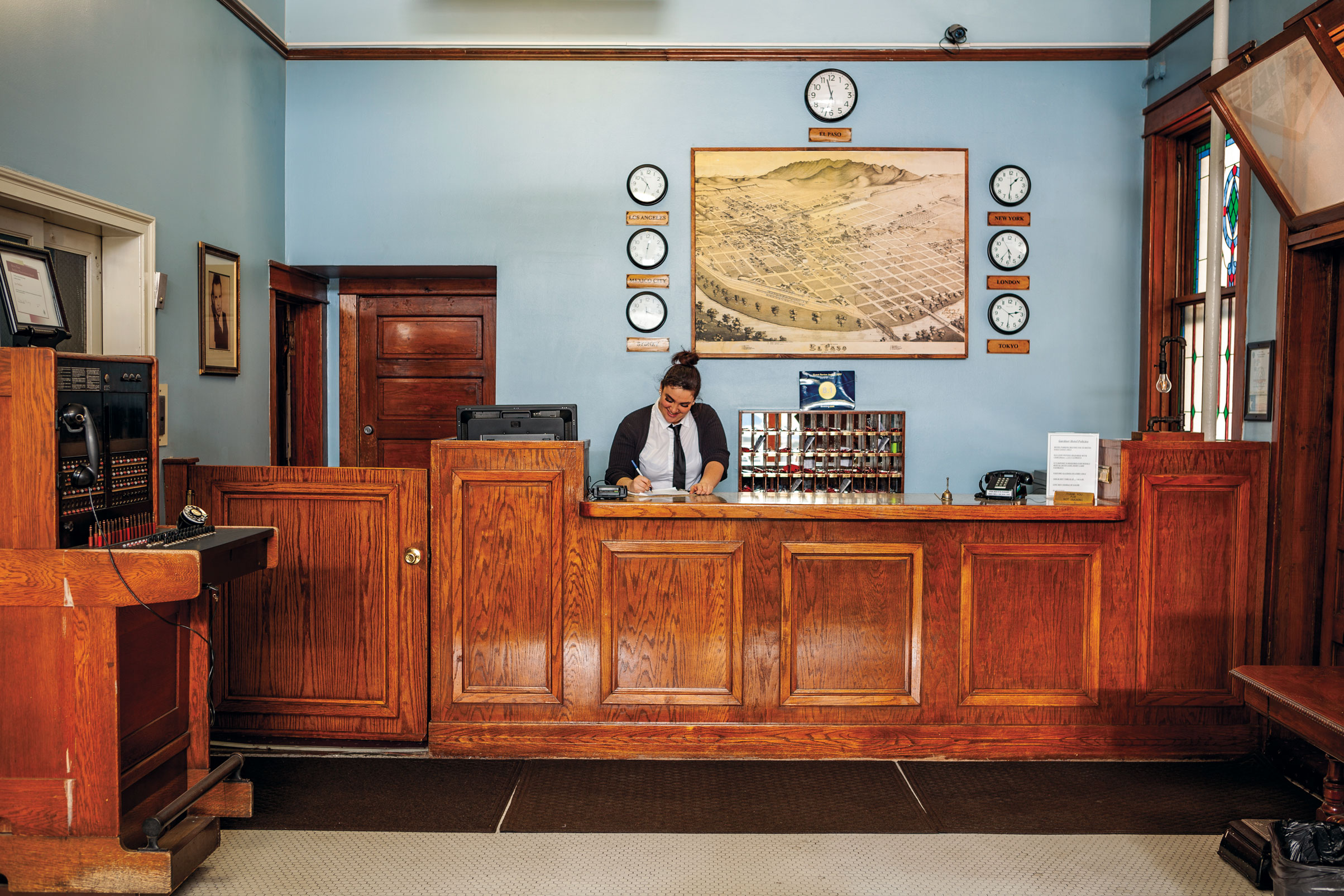
The celebrated gardner hotel has housed guests ranging from novelist Cormac McCarthy to bank robber John Dillinger.
Another candidate for McCarthy'south "one-time hotel" is the 3-story Gardner Hotel on East Franklin Avenue, one of downtown El Paso'due south liveliest strips. Stepping into the lobby of the 1922 hotel, it'due south easy to imagine a gangster in a three-slice suit brandishing a pistol from the marble staircase. After all, the famous banking concern robber John Dillinger checked in to room 220 in 1934 under the allonym John D. Ball. Mayhap that's why picture show director Sam Peckinpah asked to film scenes from the Steve McQueen movie The Getaway here. (The hotel declined; Peckinpah's plans chosen for blowing upwardly the lift.) When asked almost the hotel's history, the front desk clerk notes, "Well, Cormac McCarthy wrote here. It's where he got the thought for his book The Road."
Ahhh, the misty, cryptic nature of legends. Perhaps this is the "old hotel" McCarthy was referencing. McCarthy lived and wrote at the Gardner on and off for years back when information technology was a single-room occupancy outfit. "I would say that Cormac outset started staying here in the early to mid-'70s," owner Joe Nebhan says. "And I approximate the last time he lived at the Gardner was in the early '80s when I took over. He wasn't there long after that. By then he'd gotten that MacArthur grant and could afford to rent a place. He was always a very dainty gentleman."
Sometimes anything seems possible in El Paso. It's equally if the border culture and desert spaces open broad the windows for writers, musicians, and artists.
The Gardner is no longer populated by struggling writers and the elderly; now rooms start at $70, and a bed in the hostel dormitory is $27. Just Nebhan's recollections of its earlier days imply it would have been a fertile environment for a author. "I started going there when I was 8 years old and my dad ran the place," says Nebhan, at present in his 60s. "I thought I was a big shot past running the elevator. I got to meet some really groovy people, like veterans from the Spanish-American War."
Fifty-fifty now the Gardner feels like the setting of a McCarthy novel, and that's because it is. McCarthy mentions the hotel in the epilogue of the Border Trilogy (a series that includes All the Pretty Horses, The Crossing, and Cities of the Obviously) when grapheme Billy Parham, now an old man, lives at the Gardner before he is kicked out, meets a mysterious expiry-like character, and finally finds redemption.
While such mysteries linger like the final notes of "El Paso" drifting from the jukebox, information technology is articulate that this border city has long stoked the flames of creative minds—and those flames are now an ineluctable function of the mythos of El Paso. Even the newer and shinier iterations of local culture foster this spirit, as evidenced at Hotel Indigo, where a print on the bathroom wall reads like a manifesto for travelers seeking this city'due south inspiration, words from none other than The Route: "Go along a little burn down burning," McCarthy wrote, "however small-scale, withal hidden."
Source: https://texashighways.com/eat-drink/dining/from-rosas-cantina-to-the-road-el-paso-has-inspired-many-a-twisting-tale/
0 Response to "The Crossing Cormac Mccarthy Lone Man in Desert Art"
Post a Comment